 Museum
Lecture on the history of tropical medicine – 6pm on March 19, 2026 at the Institut Pasteur
The French Committee for the History of Health Administrations (CHAS), chaired by Roselyne Bachelot-Narquin, is continuing its lecture series on France's historical and contemporary role in global health. The lecture series highlights the contribution of France and its institutions and stakeholders to international cooperation in the field of health since the 19th century.
After a first lecture on the early days of health diplomacy and France's pioneering role in the international negotiations on disease outbreaks in the 19th century in particular, a second lecture will look at "French tropical medicine and global health (1870-1940)," highlighting the role of France's military physicians and scientific networks in the production and international circulation of medical knowledge.
A historical perspective on our scientific networks
In the late 19th century, as colonial empires were expanding and microbiology was revolutionizing medical knowledge, French physicians in the army, navy and colonial forces, especially those involved in establishing medical systems in France's colonies, helped to develop what was known as "tropical" medicine. The Institut Pasteur, on the front line in tackling epidemic diseases, was central to France's international medical presence in the first half of the 20th century.
The aim of this presentation is to show how the "Pasteurian laboratory" spread across the world, even beyond the limits of the French Empire, and to explore how these physicians became involved in international scientific networks, where they were able to make a decisive contribution to scientific progress and efforts to tackle infectious diseases. The presentation will particularly focus on flows of knowledge from France to its colonies and to the rest of the world, as well as the links between research and medical practice, as seen from the perspective of the medicalization of the colonial empire and the development of international public health.
The lecture will be given by:

Claire Fredj, a historian and professor at Université Paris Nanterre and site director of the Institutions and Historical Dynamics of the Economy and Society (IDHE.S) laboratory

Benoît Pouget, a historian and lecturer in contemporary history at Aix-Marseille Université and Sciences Po Aix and member of the Mediterranean Center for Sociology, Political Science and History (MESOPOLHIS)

The lecture will be followed by a round table led by Laurence Isnard, Head of the Pasteur Museum, with the following speakers:

Yazdan Yazdanpanah, Head of the Infectious and Tropical Diseases Department at Bichat-Claude Bernard Hospital.

Anne Marie Moulin, Emeritus Director of Research at the CNRS and a physician specializing in tropical diseases.

Eric Pichard, a specialist in infectious and tropical diseases.
Practical information
• Date: Thursday March 19, 2026
• Time: from 6 to 8pm
• Venue: François Jacob auditorium
• Attendance: the event is free but prior registration is required.
To take part in this event, please register via the online form or send an email to: comite-histoire@sante.gouv.fr
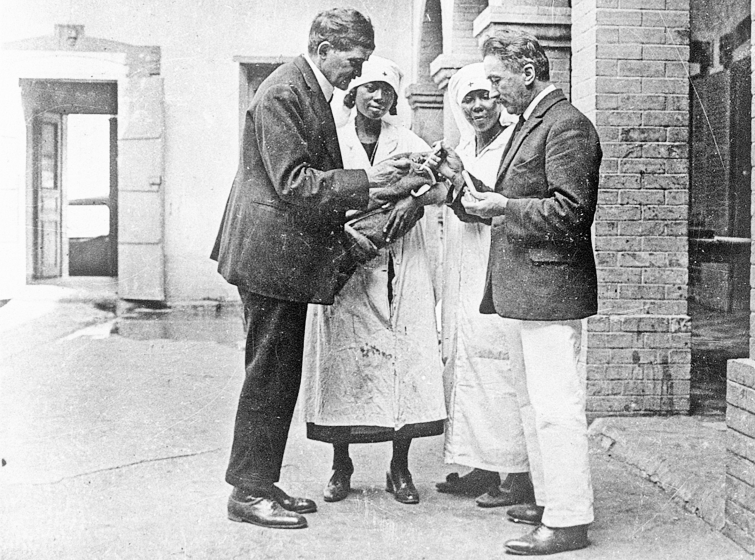
Photo : Constant Mathis vaccinant un bébé contre la tuberculose à l'Institut Pasteur de Dakar, Sénégal. En 1924, le médecin de troupes coloniales, Constant Mathis (1871-1956), fut nommé directeur de l'Institut Pasteur de Dakar.