 PASTEUR2030
Launch of the Integrative Microbiome Program: towards an integrative understanding of host-microbiome interactions

The Institut Pasteur's senior management team and Scientific Affairs Division are pleased to announce the launch of the Integrative Microbiome Program at Pasteur (IM2P). The program will be implemented and led by Benoit Chassaing, Head of the Microbiome-Host Interactions five-year group, in close collaboration with teams from all scientific departments across the campus whose research involves the study and understanding of microbiomes.
Delving into microbiotas and microbiomes
The various microbial communities hosted within the human body – collectively referred to as microbiotas – have been found to play a key role in both health and many diseases. These complex ecosystems, composed of bacteria, fungi, protozoa and bacteriophages, function as auxiliary organs, containing a genetic repertoire that is multiple times larger than the human genome. Over the past two decades, the field of microbiota research has evolved from a process of descriptive cataloging to embrace a functional mechanistic approach, revealing the role of microbiotas in protecting against certain pathogenic bacteria and their impact on metabolism, the immune system, neurological development, behavior, etc.
Since the first metagenomic sequencing of the human gut microbiota, a large body of research has demonstrated that these microbial communities do not merely "coexist" with the host; they are active agents in physiological homeostasis. What is even more extraordinary is the potential of these communities to act as "living drugs": the best developed example is fecal transplantation, which can provide a lasting cure for recurrent Clostridioides difficile infections. And given the wealth of current research and clinical trials, it seems clear that we have only begun to scratch the surface!
A topic that lends itself to cross-cutting research
At the Institut Pasteur, research on host-microbe interactions draws on a unique convergence of disciplines, including molecular microbiology, infectiology, immunology, neuroscience and computational biology. This multidisciplinary environment is conducive to in-depth integrative research into microbiota-host communication in both healthy and pathological states.
Microbiota research covers:
host-pathogen-microbiota interactions: via experimental models designed to explore how the microbiota influences susceptibility to infectious diseases,
environment-microbiota interactions: via clinical trials and preclinical models aimed at elucidating the role of environmental factors, especially diet, on the microbiota and the development of chronic diseases,
multi-omics integration: via the use of metagenomics, metatranscriptomics, metabolomics and proteomics,
gnotobiology: by breeding germ-free (axenic) mouse lines and gnotobiotic colonization models to identify causal links between specific microbial strains and host phenotypes,
culturomics: via advanced isolation and characterization protocols for anaerobic bacteria, especially those associated with host tissues.
Harnessing wide-ranging expertise for microbiome research
To coordinate these various research fields represented on campus and accelerate scientific progress, the Institut Pasteur has decided to launch the Integrative Microbiome Program at Pasteur (IM2P). This program will now serve as a strategic hub for microbiome-related research on campus. The program’s primary objectives include fostering ambitious new scientific, industrial, and philanthropic collaborations, as well as strengthening integrative and translational research on the microbiome by promoting cross-disciplinary collaboration among teams. It aims to position the Institut Pasteur as a global leader in research on this topic, at a time when the microbiome is undergoing a clinical transition.
Benoit Chassaing, Head of the Microbiome-Host Interactions G5, will be coordinating this large-scale program, alongside several other Institut Pasteur scientists with expertise in the field and in conjunction with the scientific priority leaders and the Scientific Affairs Division. The program will involve close collaboration with research institutes including the Imagine Institute, the Institut Curie and Gustave Roussy, as well as the Paris Public Hospital Network (AP-HP). The Department for Scientific Programming and Incentive Actions (SPAIS) is already offering specific support for all the teams involved in the new program.
Several events have been planned to share the latest knowledge and strengthen links between internal and external scientists involved in research fields related to the microbiome. Make sure you note the dates in your diaries!
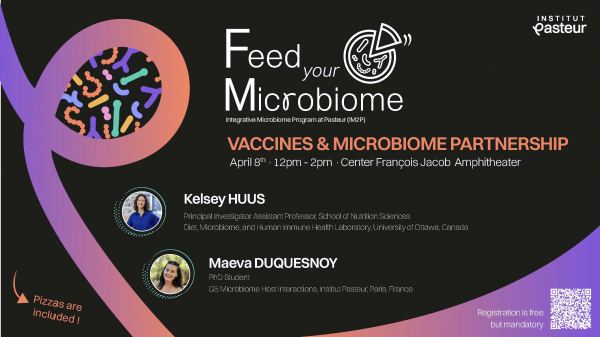
The first event, entitled "Feed your microbiome,” will be held on April 8 at 12 noon in the François Jacob auditorium, with speakers Kelsey Huus, Principal Investigator and Assistant Professor in the School of Nutrition Sciences – Diet, Microbiome, and Human Immune Health Laboratory at the University of Ottawa in Canada, and Maeva Duquesnoy, a PhD student in the Microbiome-Host Interactions Unit. The two scientists will present their research on the relationship between the microbiota and vaccination (see below).

If you have any questions about specific technical approaches or collaboration opportunities, or if you would be interested in joining this scientific network, please send an email to the following address: PilotageMicrobiomeProgram@pasteur.fr
Three questions to Benoit Chassaing, Head of the Integrative Microbiome Program

1- Can you describe the work carried out and the key steps taken over the past two years in preparation for the launch of this program, and share a little about the aims and drivers of the initiative?
"Two years ago, it became clear that around 40 Institut Pasteur teams were working on the microbiota, each with their own expertise, but in a piecemeal, uncoordinated way. So I decided to map the work of these teams, and I realized that in strategic terms, the microbiota is a cross-cutting driver that naturally intersects with the four scientific priorities in the Pasteur 2030 Strategic Plan: infectious disease threats (colonization/resistance), environmental transitions, the origins of diseases, and health at the extremes of life.
These efforts were supported by the senior management team, the Scientific Affairs Division and the SPAIS, and soon experts on campus and key partners such as Imagine, Curie and AP-HP also got involved. The aims are threefold: scientific – launching new collaborative, integrative and translational projects that position the Institut Pasteur as a key contributor to microbiota-related clinical applications; human – attracting talent and helping develop the careers of early career scientists; and financial – working together to target major international calls for proposals and public-private partnerships in the field of microbiota research."
2- How many units will be involved in the program, and how does this new structure fit together with the scientific priorities in the Pasteur 2030 Strategic Plan?
“The program involves around 40 teams on campus, including microbiologists, immunologists, neuroscientists and bioinformaticians. The cross-cutting approach directly feeds into the four priorities of Pasteur 2030: infectious disease threats (antibiotic resistance, the impact of ecosystems on certain bacterial or viral infections); environmental and nutritional transitions; origins of diseases (inflammation, metabolism and neurodegeneration); and health at the extremes of life (vaginal microbiota, perinatal development and aging). Several teams will therefore have the opportunity to contribute their specific scientific expertise to this integrative, translational vision.”
3- What events and activities will be organized in the short, medium and long term to give the Pasteurian community new insights into microbial communities?
"In the short term, the "Feed your microbiome" series will be held every two months (starting on April 8 with Kelsey Huus and Maeva Duquesnoy), combining junior Institut Pasteur researchers with internationally renowned guest experts, in an informal atmosphere including lunch, to explore a specific topic. In the medium term, a conclave will be organized in the autumn between PIs on campus and international leaders to map out the direction of microbiota research on campus over the next 20 years. Finally, an international symposium to officially launch the program at the end of the year will firmly position the Institut Pasteur as a leading global center for microbiome research!"
Focus on: The first "Feed your microbiome" event on Wednesday April 8 at 12 noon

A series of events entitled "Feed your microbiome" is being launched to kick off the Integrative Microbiome Program at Pasteur. These events, held every two months, will be an opportunity to share knowledge, expertise and the latest scientific breakthroughs on the microbiome in a relaxed atmosphere, with a guest speaker and a scientist from the Institut Pasteur.
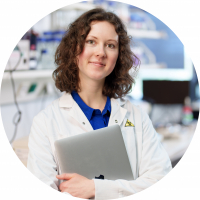

The first session will take place on Wednesday April 8 at 12 noon in the François Jacob auditorium. Kelsey Huus, Principal Investigator and Assistant Professor in the School of Nutrition Sciences – Diet, Microbiome, and Human Immune Health Laboratory at the University of Ottawa in Canada, and Maeva Duquesnoy, a PhD student in the Microbiome-Host Interactions Unit, will speak about their research on the relationship between the microbiota and vaccination.
Sign up
Pizzas will be served after the event to make sure that by the end of the evening you will have satisfied both your scientific curiosity and your gut microbiota.

And keep an eye on the newsletter for information about future events organized by the Integrative Microbiome Program at Pasteur.