 Museum
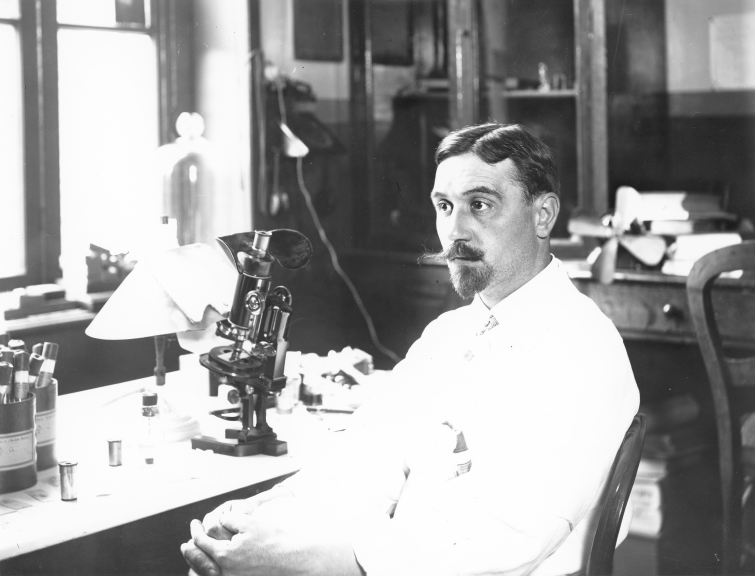
René Legroux, first curator of the Pasteur Museum
On the 75th anniversary of the death of René Legroux (1877-1951), the museum team looks back at the career of this dedicated scientist who also headed the Pasteur Museum when it opened in May 1936.
From family legacy to scientific vocation: how René Legroux joined the Institut Pasteur
René Legroux seemed predestined for a career as a hospital physician in Paris, following in the footsteps of his father and grandfather. He first came to the Institut Pasteur in 1904 as a student on the technical microbiology course. Legroux was inspired by the course, and the lecturer Émile Roux (1853-1933) sparked in him a passion for research. So once the course was over, René Legroux decided not to sit the exam to access the next stage of his medical studies but instead to accept Émile Roux's offer to continue his theoretical training in microbiology. In 1906 he was appointed as a laboratory preparer and assistant for the course (see inset "Did you know?") and taught "rigorous Pasteurian technique," attaching great importance to the careful preparation of practical sessions, double-checking every subculture and every microbial colony and correcting the slightest technical errors with ruthless precision. From 1910 onwards, he became a laboratory head and began giving lectures on culture media. When Jean Binot died in 1909, he took charge of maintaining the Institut Pasteur's bacterial collection, a role he held until 1948. He added several aerobic and anaerobic species to the collection. He became coordinator of the microbiology course in 1921, taking over from Émile Roux, and held the position for several years, training generations of scientists from France and further afield.
Did you know?
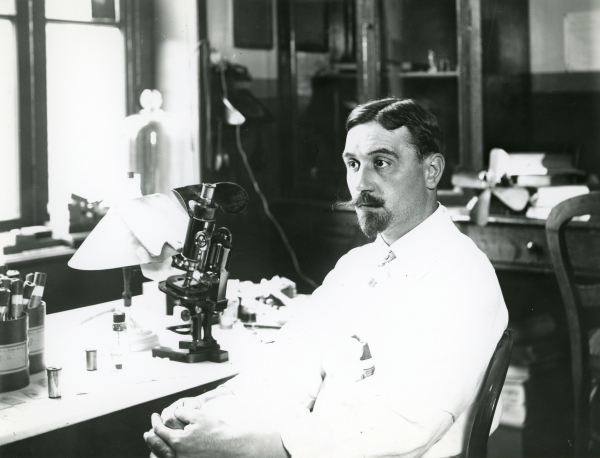
En 1905, René Legroux began working with Jean Binot on a voluntary basis before being officially appointed as a laboratory preparer in 1906. In May 1906, during an exam for the position of departmental hygiene inspector, he prepared bacterial strains for the practical laboratory tests. In recognition of his work, Émile Roux gave him 50 francs. In an article,[1] Jean Levaditi tells the story of how Jean Binot handed the money to René Legroux, urging him to refuse it but to thank Émile Roux for the gesture. This unexpected refusal by Legroux led Roux to offer him a permanent position and a monthly salary of two hundred francs, starting in January 1907.
Contribution during the First World War
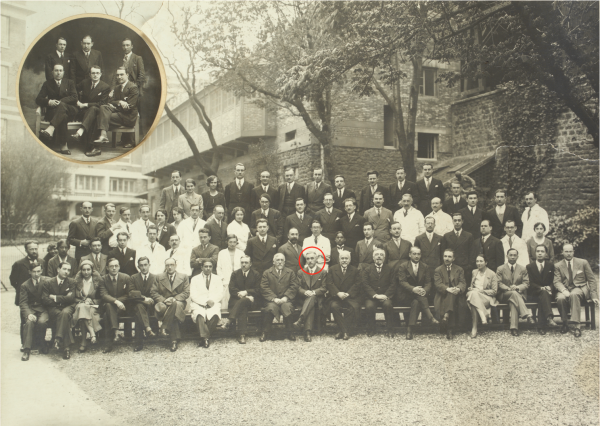
In 1914, René Legroux was called up to serve at the Institut Pasteur at the request of Émile Roux. He made many contributions to the war effort which were of vital importance to the Health Department.[2] In just a few days, he turned the teaching laboratory into a vaccine production unit. Over a two-month period, he supplied 2,200,000 doses of typhoid vaccine for the armed forces and the civilian population.[3] Vaccination helped prevent at least a million soldiers from contracting typhoid.[4] On October 27, 1914, Legroux was appointed as director of the organization center for the army laboratories.[5] He proved to have excellent organizational skills, converting the two microbiology classrooms into a "factory" for preparing equipment to be used in mobile laboratories.
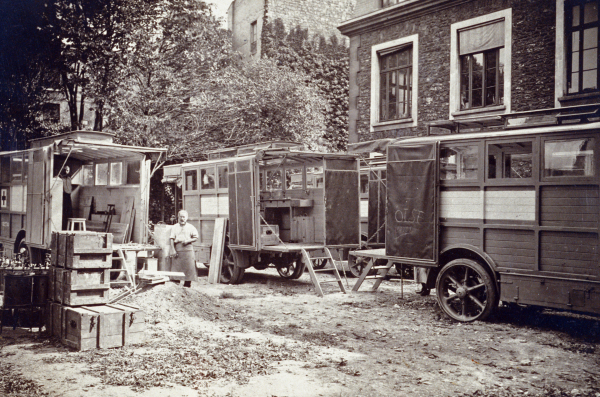
In just a few months, he created dozens of laboratories for use by the Health Department,[6] including mobile bacteriological laboratories often referred to as "Legroux Ambulances."[7]
Starting in January 1917, René Legroux organized an antimalaria mission aimed at the army fighting on the Eastern front. For this strategic mission, he provided not only comprehensive parasitological and chemical equipment but also significant reserves of quinine.[8] Aware of the importance of prevention, he ran an extensive antimalaria information campaign involving leaflets, postcards and posters. Thanks to these efforts, the troops in the Eastern army did not succumb to malaria and were able to lead a victorious campaign in Macedonia.[9] Alongside these logistical tasks, Legroux also played a key educational role, providing serving physicians assigned to army laboratories with training in bacteriological techniques and methods for identifying the main pathogenic microbes. He also wrote several information sheets on bacteriological and epidemiological techniques for the Health Department. In November 1917, he was given a new responsibility when he was tasked with organizing the laboratories that would be needed for the US army, which had begun to arrive in France.
René Legroux, first curator of the Pasteur Museum
René Legroux was committed to serving the Pasteurian tradition, dedicating his entire life to the Institut Pasteur. He proudly gave himself the title of “curator of the Pasteur Museum.”
He was responsible for establishing the Pasteur Museum in 1936. His role involved assembling all the artifacts left by Louis Pasteur in his successive laboratories. It was Legroux who created the "Scientific Souvenir Room," which still contains equipment, microscopes, labeled flasks and models of crystals that Louis Pasteur fashioned himself.
Support the restoration of Louis and Marie Pasteur's appartment Louis and Marie Pasteur's appartment is a cultural and historical heritage site that must be preserved. Louis and Marie Pasteur spent their final years in this apartment, from February 1889 onwards. The rooms, conserved in their original state, offer a glimpse of the global reputation of the scientist, who had become the "benefactor of humanity" with his rabies vaccine in 1885, and also the daily life of a bourgeois household in the late 19th century. The apartment includes the "scientific souvenir room," created in 1938 to display Louis Pasteur's scientific instruments and laboratory glassware. Louis Pasteur, who died in 1895, was buried with his wife in the neo-Byzantine-style crypt in the same historical building where he had spent his last years. The former apartment, now the Pasteur Museum, was recognized under the "Maisons des Illustres" scheme in 2012. The Fondation du Patrimoine, a private French organization with recognized charitable status that aims to safeguard and promote the country's heritage, is supporting the Institut Pasteur. To help raise the funds needed to restore Louis and Marie Pasteur's apartment, the Fondation du Patrimoine has launched an online appeal. The total cost of the work to restore the apartment and Pasteur Museum is estimated at €2,600,000.
The aim is to fully open this major heritage site to the public in November 2028, coinciding with the Institut Pasteur's 140th anniversary. |
If you are interested in the latest museum news or have any questions, feel free to contact the museum team at musee@pasteur.fr and follow us on social media (LinkedIn, Instagram)
[1] Jean Levaditi, "Souvenirs, comment on entrait à l'Institut Pasteur au début du siècle"
[2] Source: Pasteur Vallery-Radot (Louis), "René Legroux (1877-1951)," La Presse Médicale, no. 17, p. 341, 17/03/1951
[3] "René Legroux (1877-1951)," Annales de l'Institut Pasteur, vol. 80, p. 332, 1951
[4] https://www.pasteur.fr/fr/journal-recherche/actualites/pasteuriens-grande-guerre
[5] "René Legroux (1877-1951)," Annales de l'Institut Pasteur, vol. 80, p. 332, 1951
[6] Op. Cit.
[7] Annick Perrot and Maxime Schwartz, "Les laboratoires volants," Le génie de Pasteur au secours des poilus, Chapter 5, Editions Odile Jacob, 2016, pp. 55-63
[8] Op. Cit.
[9] Pasteur Vallery-Radot (Louis), "René Legroux (1877-1951)," La Presse Médicale, no. 17, p. 341, 17/03/1951