 event
event
Advancing autism research by making our voices heard: focus on the Venite Cantemus charity concert in aid of the Institut Pasteur – save the date to come and listen to two rehearsals in the CIS!
Following on from yesterday's World Autism Awareness Day, an initiative introduced by the UN in 2007, the newsletter team is excited to present the charity concert Venite cantemus, in aid of the CONTEXT project led by Thomas Bourgeron's unit.
Read on to find out more about:
the concert,
the involvement of Institut Pasteur staff who are singing in the event,
the two open rehearsals held on campus that anyone can attend,
interviews from those at the Institut Pasteur working on cutting-edge autism research.
Venite Cantemus – singing in support of medical research on mental illness
The "La Girafe Lyrique" association is gearing up for the sixth edition of its Venite Cantemus initiative, which will see 700 singers performing en masse at a concert in aid of the Institut Pasteur, held at the Théâtre des Champs-Elysées in Paris on June 21, 2026.
This year, La Girafe Lyrique, an association that funds medical and participatory research on mental illness, has decided to support the CONTEXT project led by Thomas Bourgeron and his team. The aim of the project is to bring together people affected by neurodevelopmental disorders (NDDs) and scientists from various disciplines, in France and in other countries. Together, they will develop a comprehensive, accessible knowledge base on the genetic components of NDDs, situating them within the broader context of human neurodiversity. The project will promote multidisciplinary, translational and participatory research, embracing collaborative methods to drive progress in the field of NDDs. In practical terms, CONTEXT will develop resources containing information about the genetics of NDDs, especially those for which there is still little information about the genetic component (including AD(H)D, autism without intellectual disability and dyspraxia).
A closer look at the involvement of Institut Pasteur staff in the choir set to perform on June 21
Back in December, La Girafe Lyrique invited Institut Pasteur staff to join the choir and sing in the concert. Nearly 30 staff members – sopranos and altos, tenors and basses, both support staff and scientists – answered the call to join this unique choir and sing in aid of research.
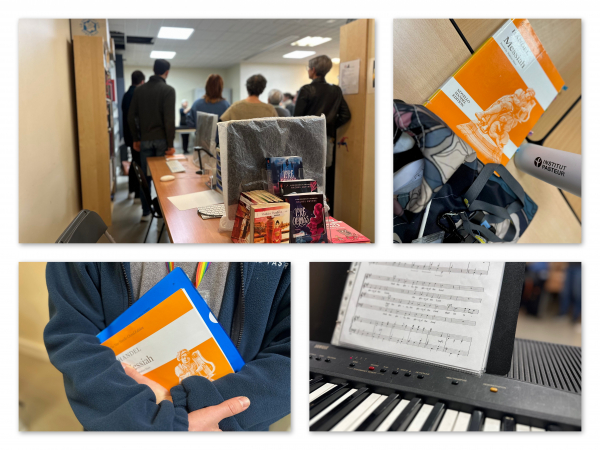
Under the leadership of conductor Marie Nguyen de Bernon, the 29 budding vocalists from the Institut Pasteur have been meeting every Thursday lunchtime since February to rehearse Handel's Messiah together in preparation for a performance on June 21. The experience has created a close bond among the group, who are enjoying the opportunity to rehearse together in a fun and relaxed atmosphere.

"Twelve years ago, I joined the Institut Pasteur choir as a soprano. Passionate about singing, I joined the Institut Pasteur Vocal Group two years later, where choral singing was taught in small groups; there, I studied successively under B. Boisvieux, I. Mooney Lopez, and A. Gallet. Since 2021, I have also been taking private opera singing lessons with Elizabeth Fernandez, a soprano and voice teacher at the Conservatoire de Plaisir. Three years ago, Patrick Weber, the founding director of the Institut Pasteur choir and its conductor for over 30 years, took me under his wing and offered me the opportunity to become his assistant with the aim of succeeding him upon his retirement. I accepted enthusiastically. This will be an opportunity for me to reconnect with the piano.
When La Girafe Lyrique invited the Institut Pasteur to participate in the Handel’s Messiah project, I was among the thirty or so Pasteurian choristers who embarked on the adventure. This wonderful project allows me to put my new skills in choral conducting into practice."
Marie Nguyen de Bernon
Come along to two open rehearsals on campus before the concert on June 21: save the date!

On Monday May 18 and Wednesday June 10, the Institut Pasteur will host two rehearsals organized by La Girafe Lyrique on campus. The two sessions will be held in the CIS from 6pm and are open to all. Those who attend the rehearsals will have the opportunity to see a massed choir of more than 200 people from Greater Paris – including your colleagues! – together with the official musicians.
We hope that lots of you will take the opportunity to come along and hear Handel's Messiah in May and June. The newsletter team will send out regular reminders for these dates!
Profile of Thomas Bourgeron and interview with his colleague Stef Bonnot-Briey – an Institut Pasteur duo committed to advancing participatory research on autism
On March 31, 2003, an international team led by psychiatrists Professor Christopher Gillberg and Professor Marion Leboyer and geneticist Professor Thomas Bourgeron first revealed the existence of genetic mutations linked to autism. This discovery was the start of a new era for the medical community, scientists and families affected by autism. Today, the research teams in Thomas Bourgeron's laboratory are continuing to deepen our knowledge about autism.
The newsletter team is pleased to present a profile of Thomas Bourgeron in three questions and an interview with his colleague Stef Bonnot-Briey for a special autism episode of the Big Bang program and podcast produced by France Inter:

Three questions to Thomas Bourgeron, Head of the Human Genetics and Cognitive Functions Unit, involved in the discovery of the first genes associated with autism, who has been working in the field for many years:
1- Could you briefly introduce yourself for any Institut Pasteur staff who don’t know you?
I started with chess, then music, before turning my attention to plant biology. At the time, as an enzymologist, every week I peeled four kilos of potatoes to isolate succinate dehydrogenase in potato mitochondria!
I then completed a PhD on mitochondrial diseases under the supervision of Pierre Rustin and Agnès Rötig, in Arnold Munnich's laboratory. I gradually became a geneticist, identifying the first nuclear mutations affecting the Krebs cycle and the respiratory chain in humans. These mutations caused severe neurological disorders in newborn infants.
I obtained a lectureship and joined Marc Fellous' laboratory at the Institut Pasteur, where I worked on sex determination and male infertility with Ken McElreavey. When I identified a new gene in a region associated with psychiatric disorders, my interest turned to autism, and in 2003 I identified the first genes involved in the condition. At that time there were three of us in the laboratory: Hélène Quach, a technician, Stéphane Jamain, a PhD student, and myself. We worked closely with the psychiatrists Marion Leb (R2D2-MH) and within France by coordinating the genetics and databases part of the new Child Brain Institute.
2- Could you explain how your research took you outside the walls of your laboratory?
The identification of the first genes associated with autism was a major breakthrough on several levels. First, it helped ease the guilt felt by parents, who had long been considered as responsible for their children's autism. Mothers in particular were accused of being cold and rejecting their babies.
Our findings also overturned the notion that autism was an exclusively multigenic condition. In the cases that we identified, a single genetic variation – among more than three billion letters in the genome! – was all it took to cause major difficulties in cognitive development, social interactions and language. Our first results were not well understood by the scientific community. It was precisely 20 years ago, with the identification of the first genetic mutations in SHANK3, that we convinced the community that a single genetic variant could prevent the development of language skills. The SHANK3 gene is now known to be the most commonly mutated gene in autism.
Finally, these genes encode proteins that are essential for the functioning of synapses, the points of contact between neurons. This discovery paved the way for the identification of several other genes involved and led to a better understanding of the underlying mechanisms, and the development of targeted clinical trials for people with autism experiencing major difficulties.
3- What initiatives are you involved in, what associations are you in contact with, and how will World Autism Awareness Day on April 2 provide you with more visibility among the general public and key public stakeholders?
Genetics is the science of diversity, and our team is committed to both improving the care pathway for people with autism – from diagnosis to clinical trials – and increasing recognition of neurodiversity. Since we are not all neurotypical, society needs to do more to support atypical individuals, whether at school, at work or in all aspects of daily life, as well as in research of course!
Our research is now participatory – we are keen to directly include people with autism and their families in the co-development of research projects. This approach is proving to be hugely valuable and revealing new aspects of autism. For example, we are working to improve understanding of the often highly atypical sensory processing in people with autism, which has previously been neglected in research.
This means reducing the stigma that people with autism and their families face on a daily basis, and also adapting support measures to meet the needs and wishes of each individual. Our aim is for each person, including those with vulnerabilities, to be able to represent themselves and achieve their full potential. This is an achievable challenge as long as we all work together and join our efforts.
The financial support provided by Venite Cantemus for the CONTEXT project (a charity concert is being held on June 21 to raise funds) will help advance research by integrating the experiential knowledge of people affected by autism. In creating links between science, lived experience and artistic creation, this project is helping improve both understanding and quality of life. I am delighted!
PInterview with Stef Bonnot-Briey for the Big Bang radio program on France Inter on February 28
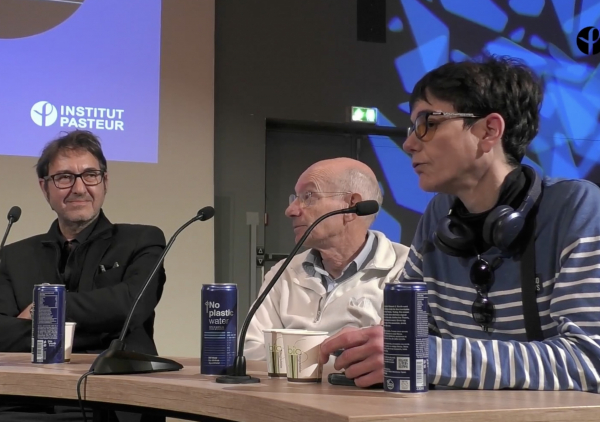
During a special edition of Big Bang on autism, broadcast by France Inter, Thomas Bourgeron and Stef Bonnot-Briey spoke about the importance of participatory research and the complementary nature of academic and experiential knowledge.
Stef Bonnot-Briey presented her role as an expert by experience in autism.
Excerpt from the broadcast: "I am an expert by experience in autism, having co-founded several associations including AUTOP, a federation of associations co-founded by disabled people, and I work in participatory research. In participatory research, experts by experience are directly involved (not just for autism; also in areas such as HIV/AIDS, alcoholism, etc.). They can also be families. They bring knowledge gained by experience, offering a different, complementary perspective."