 Museum
Museum on tour: Exhibition "Creating crystals, a journey between art and science"
The Pasteur Museum is a partner of the exhibition Créer le cristal, voyage entre art et science (Creating crystals, a journey between art and science), on display in the minerals collection at Sorbonne University from January 20, 2026 to January 2, 2027.

The exhibition explores humanity's long-held fascination for crystals – whether for their perfection and beauty, their physical and chemical characteristics or the healing properties with which they have long been associated. Visitors are presented with a brief history of crystals, from the minerals found in nature to the lengthy research on crystal synthesis. Efforts to synthesize crystals today are aimed not just at reproducing these natural masterpieces, but also at inventing materials with unique properties that can meet society's needs and enable us to explore new frontiers. The exhibition shows how crystals are everywhere in our daily lives, used in a wide range of tools and instruments, and how studying them at different scales is crucial in helping us understand the function and dysfunction of living systems.
As well as presenting technical and innovative aspects, the exhibition also creates a fascinating dialog between the scientist's lab and the artist's workshop. By exploring topics such as material, growth and "controlling" chance, creations by Léa Barbazanges, Vincent Gontier and Ada Yu and photographs by Robin Guittat draw a poetic and esthetic link with the history of research into organic and inorganic crystal synthesis.
Collections from the Pasteur Museum in the exhibition
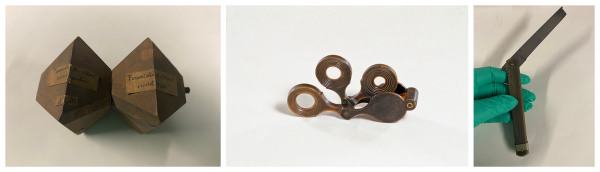
The Pasteur Museum has loaned ten objects from its collection. These include:
- A wooden model representing the "left-handed" and "right-handed" forms of strontium formate. This wooden model of strontium formate crystals was presented by Louis Pasteur to the French Academy of Sciences on September 30, 1850
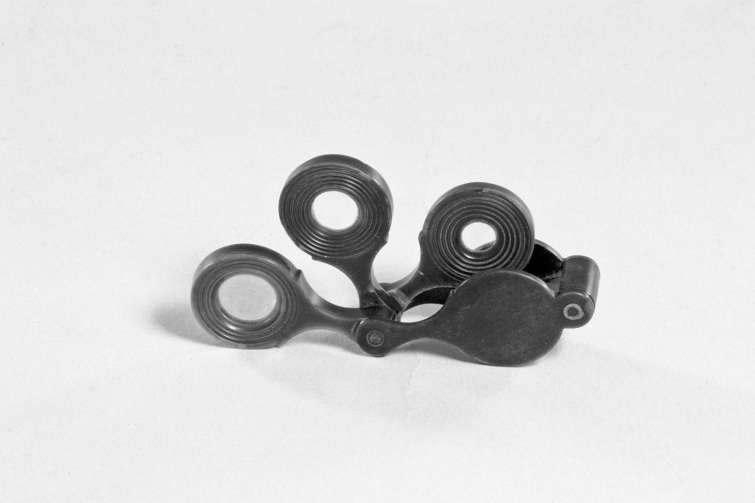
- The triple magnifying glass used by Louis Pasteur to observe crystals when he began his stereochemistry research
- The knife he used to carve crystal models out of wood
Louis Pasteur began his scientific career as a chemist. He graduated with a degree in science in 1845 and a doctorate in science in 1847, defending two theses at the University of Paris – one in chemistry and the other in physics:
- Research on the saturation capacity of arsenic acid. Study on the arsenites of potash, soda and ammonia.
- Study on phenomena related to the rotatory polarization of liquids. Application of the rotatory polarization of liquids.
He then set out to address the problem raised by German physician Eilhard Mitscherlich (1794-1863): why do two seemingly identical chemical substances – sodium ammonium paratartrate and tartrate – have a different effect on polarized light? This led him to discover the concept of molecular dissymmetry, or chirality, which is still a highly topical subject today given the latest research on mirror life.
The museum is organizing a visit to the exhibition on Friday March 13 from 1 to 2pm (spaces limited).
Registration required by March 6, 2026 by emailing musee@pasteur.fr. You will receive a confirmation message.
You can also visit the exhibition during the opening times in the minerals collection at Sorbonne University, from Tuesday to Saturday, 1 to 6pm.
Place: Sorbonne University, 4 place Jussieu, 75005 Paris
Access: entrance to the exhibition is at the Saint Bernard level, Patio 14-25, next to lecture hall 25 (between towers 24 and 25).
|

If you are interested in the latest museum news, have any questions or are in possession of any technical or scientific objects that can provide clues to the past activities of the Institut Pasteur's laboratories, feel free to contact the museum team at musee@pasteur.fr and follow us on social media (LinkedIn, Instagram).